
Narra Wood: The Hardwood With a Split Personality
Quick Answer: What Is Narra Wood?
Narra wood comes from Pterocarpus indicus, a tropical hardwood native to Southeast Asia and parts of the western Pacific. It is known for its warm golden to reddish-brown color, good natural luster, interlocked grain, and occasional dramatic figure. When Narra grows burl, that burl is often sold as Amboyna burl, one of the most sought-after burl woods in the world.
For a cane maker, Narra is interesting because it has two very different personalities.
Plain Narra can be steady, warm, and handsome.
Figured Narra can be full of movement.
Amboyna burl can be flat-out ridiculous.
And I mean that in the best possible way.
Why Narra Earns a Spot on the Bench
Some woods are loud the second you look at them. Some take a little longer.
Narra can do both.
A clean piece of Narra has a warm, classic look. It can range from golden yellow to reddish brown, often with enough depth to make you want to turn it under the light a few times before making any decisions. But then there are the figured pieces. Curly, mottled, beeswing, ribbon stripe, burl. That is where Narra starts getting dangerous.
Dangerous for the wallet, mostly.
For Caravelle Creations, Narra is the kind of wood that makes sense for a custom cane because it brings beauty without becoming fragile or fussy. It has presence. It finishes well. It can carry a polished, premium look without needing to shout.
That is usually the sweet spot.
A cane should not just be decorative. It needs to feel right in the hand, hold up to use, and still have enough character that someone notices it from across the room.
Narra checks a lot of those boxes.
The Basics: Narra at a Glance
Scientific name:Pterocarpus indicus
Common names: Narra, Angsana, Amboyna when burl, Malay Padauk, New Guinea Rosewood, Philippine Padauk
Native region: Southeast Asia, East Asia, and parts of the western Pacific
Tree size: Often around 65 to 100 feet tall, with some sources recording larger specimens
Average dried weight: About 41 pounds per cubic foot
Janka hardness: About 1,260 lbf
Color range: Golden yellow, reddish brown, sometimes with darker streaks
Grain: Usually interlocked, sometimes wavy
Texture: Medium to coarse
Natural luster: Good
Common uses: Furniture, veneer, cabinetry, boatbuilding, turned objects, specialty wood pieces, musical instruments, and fine craft work
Caravelle use: Custom cane work, especially when the piece has strong figure, color, or a relationship to Amboyna burl
What Narra Looks Like
The fun thing about Narra is that it does not always look like the same wood.
The heartwood can be golden, honey-colored, orange-brown, reddish brown, or somewhere in between. The sapwood is usually paler and more yellow, which can create a clean contrast when it shows up in the right place.
But the real reason woodworkers and collectors pay attention to Narra is the figure.
Depending on the cut and the individual tree, Narra can show:
Ribbon stripe
Mottled figure
Curly figure
Beeswing figure
Burl clusters
Chatoyance, or that cat’s-eye shimmer that moves as the light moves
That last one matters.
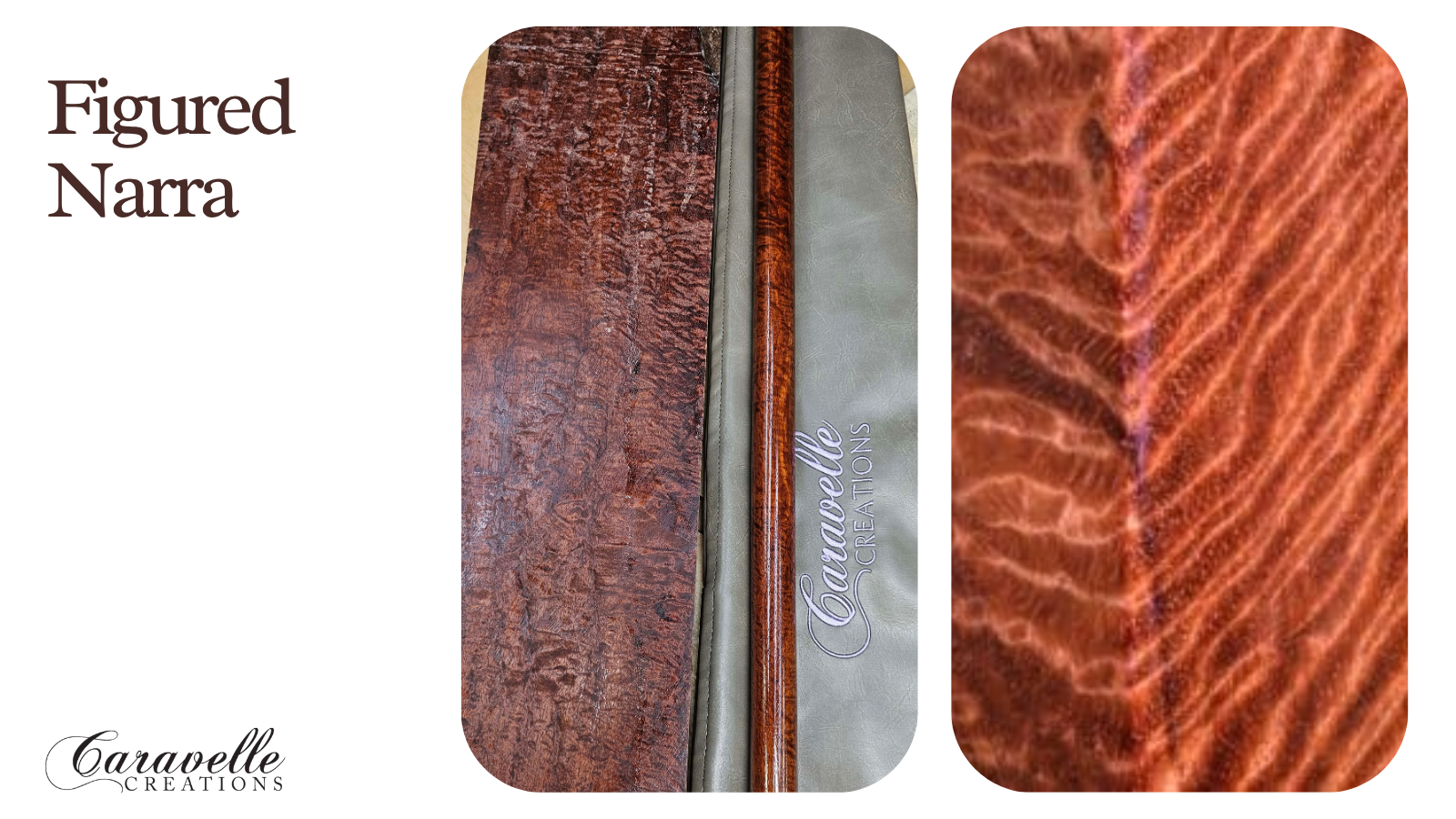
A flat photo can show color. It can show grain. It can even show contrast. But it does not always show movement. Some woods only really explain themselves when you turn them in your hand. Narra is one of those woods.
That is part of why it works so well in canes. A cane is not stuck on a wall. It moves. It catches light. It gets handled. The figure has a chance to show off without trying too hard.
Narra and Amboyna Burl: Same Tree, Very Different Personality
Here is where Narra gets especially interesting.
Amboyna burl is not usually a separate tree species. It is most often the burl form of Narra, although burl from other Pterocarpus species can sometimes be sold under the Amboyna name.
That means a piece of straight-grained Narra and a piece of Amboyna burl can technically come from the same species, even though they may look like they came from different planets.
Regular Narra is often warm, smooth, and composed.
Amboyna burl is the wild cousin who shows up overdressed and somehow pulls it off.
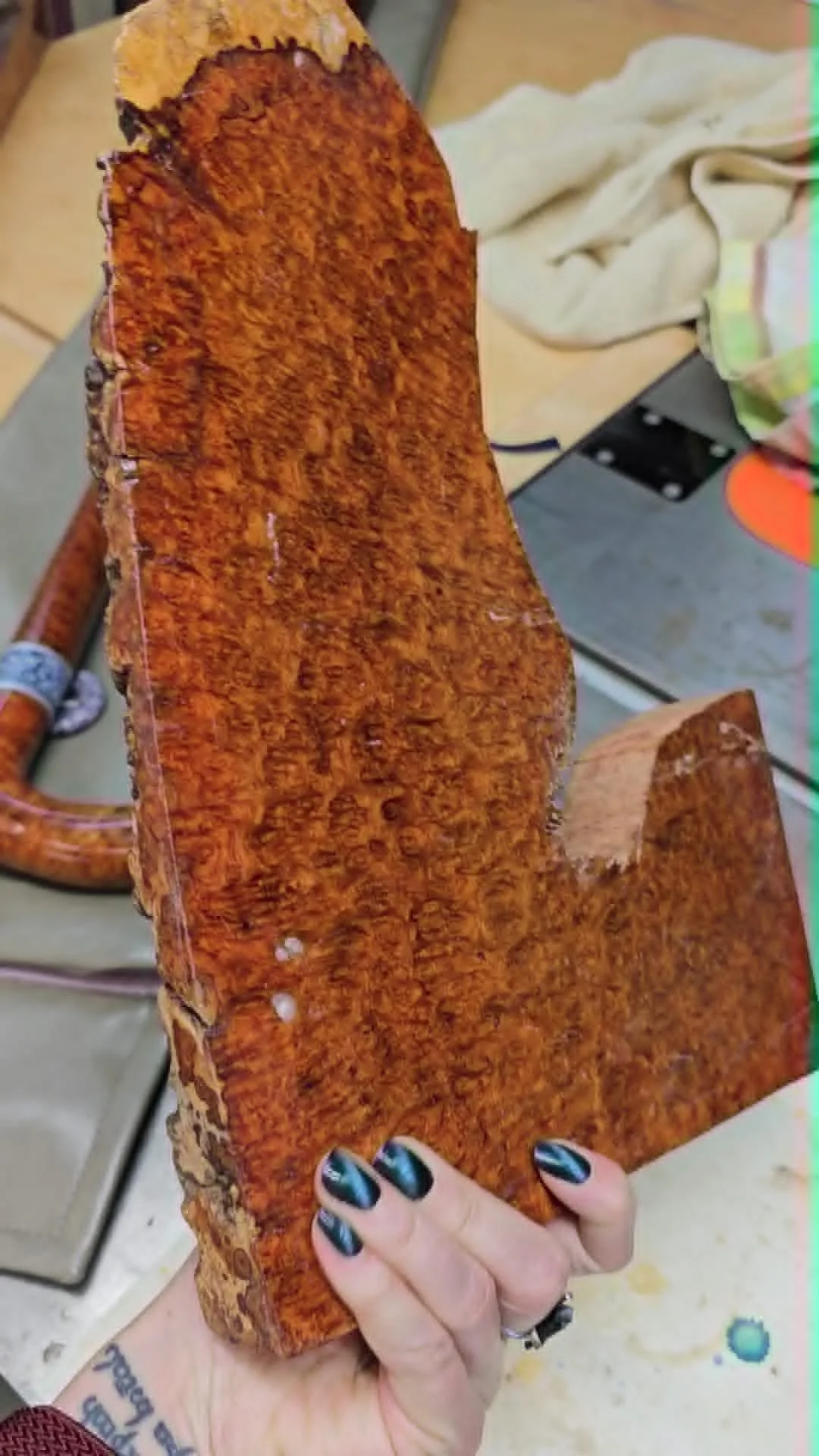
Burl forms when a tree grows in an irregular way, often producing dense clusters of swirling grain, knots, eyes, and unpredictable figure. In Amboyna burl, that can mean tight eyes, rich color, golden sapwood contrast, and a pattern that feels almost too detailed to be natural.
But that is the point. It is natural.
No printer. No stain trick. No fake pattern.
Just the tree doing something strange and beautiful.
Is Narra the Same as Red Sandalwood?
No, and this is one of those common-name traps that makes wood identification messy.
Narra can sometimes be referred to by names like “red sandalwood” in trade or regional contexts, but it is not the same as true Red Sandalwood or Red Sanders, which is Pterocarpus santalinus. That is a different species with a different origin, density, hardness, history, and regulatory baggage.
This is why scientific names matter.
Common names are useful in conversation. Scientific names keep everyone honest.
For Narra, the name to remember is Pterocarpus indicus.
How Hard Is Narra Wood?
Narra has a Janka hardness of about 1,260 lbf.
That puts it in a practical middle ground. It is harder than many common domestic furniture woods, but it is not so brutally hard that every cut feels like a negotiation.
For comparison, it is not as hard or heavy as some of the extremely dense exotic hardwoods. That can actually be a good thing for cane work.
A cane needs strength, but it also needs balance. Too much density in the wrong place can make a cane feel clumsy. The goal is not to make a club with a handle. The goal is to make something useful, comfortable, and worth looking at.
Narra gives plenty of visual richness without always bringing unnecessary weight.
What Is Narra Like to Work With?
In the shop, Narra is generally considered workable with both hand tools and machines. It turns well, glues well, and finishes well.
That does not mean it is boring.
The grain is often interlocked, and interlocked grain likes to remind you who is in charge. If you approach it carelessly, it can tear out. If you pay attention, use sharp tools, and read the direction of the grain, it rewards you.
That is one of the reasons I like woods like this.
They are not impossible. They are just not asleep.
Narra can also have a noticeable scent when worked. Some people describe it as aromatic or fragrant. Like many exotic woods, the dust can be irritating, so proper dust collection and protection matter. Beautiful wood still makes wood dust, and wood dust does not care how pretty the board was.
Why Narra Works Well in a Custom Cane
A custom cane has a different job than a cutting board, table leg, or box lid.
It has to be touched constantly.
That changes how I think about the wood.
For a cane, I am looking at:
How the wood feels in the hand
How it balances with the rest of the piece
Whether the grain can handle shaping
How the figure will look from multiple angles
How the finish will bring out depth without making it look plastic
Whether the wood has enough personality to justify being featured
Narra is especially useful when I want warmth and movement. It can be refined without being plain. It can be exotic without looking like it is trying to win an argument.
When paired with Amboyna burl, resin, bronze, maple, gidgee, or other high-character materials, Narra can either be the star or the bridge that holds the whole design together.
That flexibility matters.
Not every beautiful wood plays well with others.
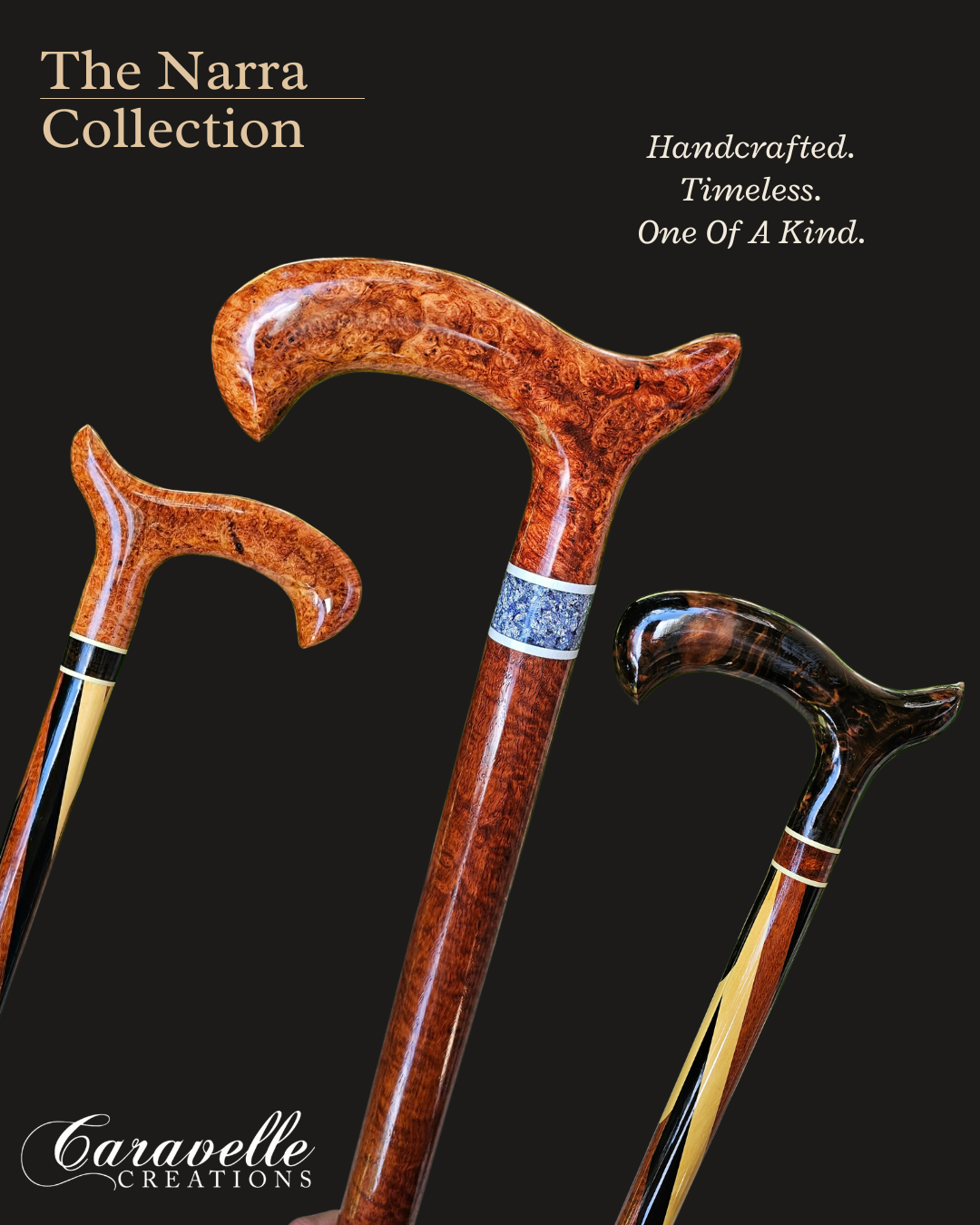
LISTINGS COMING SOON
The Narra Collection
The Narra pieces (LISTINGS COMING SOON!) have a little more story than usual because the Narra and Amboyna burl are connected. They come from the same remarkable material family, and I’ve used pieces from that Narra and Amboyna burl in more than one cane.
That gives the collection a thread.
Each cane is still its own piece. Different proportions. Different combinations. Different final personality.
But they are related.
That is one of the quiet pleasures of custom work. Sometimes the connection is obvious. Sometimes it is tucked into the material history.
Collectors tend to notice that kind of thing.
Narra’s Bigger Story
Narra is not just a pretty hardwood.
It is also a large tropical tree with cultural and ecological significance. It is recognized as the national tree of the Philippines. In life, it can produce bright yellow flowers and broad, spreading shade. Its seed pods are round and winged, which fits the genus name Pterocarpus, meaning winged seed.
Woodworkers can get so focused on boards, blanks, and finished objects that we forget these materials started as living trees. Narra is not a color swatch. It is not just “brown exotic hardwood number whatever.” It is a species with a range, a history, a reputation, and a conservation story.
And that story is complicated.
Narra has been heavily valued for timber, and wild populations have faced pressure from overharvesting and habitat loss. That does not mean every piece of Narra in a workshop is automatically irresponsible. It does mean the wood deserves respect, and sourcing should never be treated as an afterthought.
For small custom pieces, especially when using specialty blanks, old stock, offcuts, or carefully sourced material, the goal is to make the most of what is already on the bench.
Waste is not craftsmanship.
What to Look For in a Narra Piece
If you are looking at a finished cane, box, handle, or small specialty object made with Narra, here is what I would pay attention to:
Color depth: Good Narra often has warmth that changes under finish. It should not look flat.
Figure: Curly, mottled, ribbon, or burl figure can make a piece much more visually interesting.
Light movement: Turn it. Good figured wood usually gets better when it moves.
Contrast: Pale sapwood, darker heartwood, and burl eyes can create natural drama.
Finish quality: A good finish should bring out depth without burying the wood under a thick plastic-looking coat.
Design restraint: With a wood like Narra, the maker needs to know when to stop. The wood already brought plenty to the table.
Narra in One Sentence
Narra is a warm, workable, visually rich tropical hardwood best known for its golden to reddish-brown color, lively figure, and its connection to Amboyna burl.
That is the clean answer.
The better answer is this:
Narra is one of those woods that rewards a second look.
And in custom cane work, that second look is usually where the magic is.
-
Narra wood comes from Pterocarpus indicus, a tropical hardwood native to Southeast Asia and parts of the western Pacific. It is valued for its warm color, natural luster, durability, workability, and occasional dramatic figure.
-
Narra heartwood can range from golden yellow to reddish brown. Some pieces have darker streaks, ribbon-like figure, curly movement, or mottled patterns. The sapwood is usually paler yellow and can create strong contrast.
-
Yes. Narra is a hardwood. It has a Janka hardness of about 1,260 lbf, which makes it durable enough for fine furniture, turned objects, and specialty craft work while still being workable with sharp tools.
-
Yes, Narra can be an excellent wood for custom canes, especially when the piece has strong figure or color. It offers a good mix of beauty, workability, stability, and warmth without always being excessively heavy.
-
Amboyna burl is a highly figured burl wood most commonly associated with Narra, or Pterocarpus indicus. Burl growth creates tight swirls, eyes, and unusual grain patterns, making Amboyna one of the most prized burl woods for small luxury pieces.
-
Not exactly. Narra is the tree species. Amboyna is usually the burl form from that tree or related Pterocarpus species. So Amboyna can come from Narra, but not all Narra is Amboyna.
-
No. Narra is Pterocarpus indicus. True Red Sandalwood, also known as Red Sanders or Zitan, is typically Pterocarpus santalinus. Common names can overlap, so the scientific name is the safest way to identify the wood.
-
Narra is special because it combines good workability with rich color, natural luster, durability, and the possibility of dramatic figure. Its burl form, Amboyna, is especially prized by collectors and makers.
-
High-quality figured Narra and Amboyna burl can be difficult to find and expensive. Narra also has a conservation story, so responsible sourcing matters. The more dramatic the figure, the more selective a maker needs to be.
-
Narra usually finishes well. A good finish should enhance the wood’s depth, figure, and natural luster without making it look artificial. With figured Narra, the goal is usually to let the light do the talking.