
Red Gum Wood: Australia’s River-Born Hardwood With Serious Presence
Quick Answer: What Is Red Gum Wood?
Red Gum wood usually refers to River Red Gum, Eucalyptus camaldulensis, a dense Australian hardwood known for its deep red to reddish-brown color, strength, durability, and rugged grain. It grows across much of mainland Australia, especially along rivers, creeks, wetlands, and floodplains.
In the shop, Red Gum is not a quiet wood.
It has weight. It has color. It has presence. Even before it is shaped, it feels substantial in the hand.
Ancient Red Gum is an even more unusual version of the story. It typically refers to old, reclaimed Red Gum that has been preserved underground for thousands of years. During that time, minerals in the soil and water can darken the wood dramatically, sometimes turning it near-black and making it feel almost stone-like.
Regular Red Gum brings warmth and strength.
Ancient Red Gum brings time.
Why Red Gum Stands Out
Some woods are admired for flash. Red Gum is admired for presence.
The first thing most people notice is the color. Freshly finished Red Gum can have a deep red, reddish-brown, or orange-red tone that feels warm without being soft. It is not pale and polite. It has a grounded look, the kind of color that makes a finished piece feel like it already has a history.
Then comes the grain.
Red Gum can be interlocked, sometimes wavy, and occasionally full of movement. The figure is not always clean and predictable, and that is part of the appeal. It can look rugged, river-worn, and a little stubborn.
That suits it.
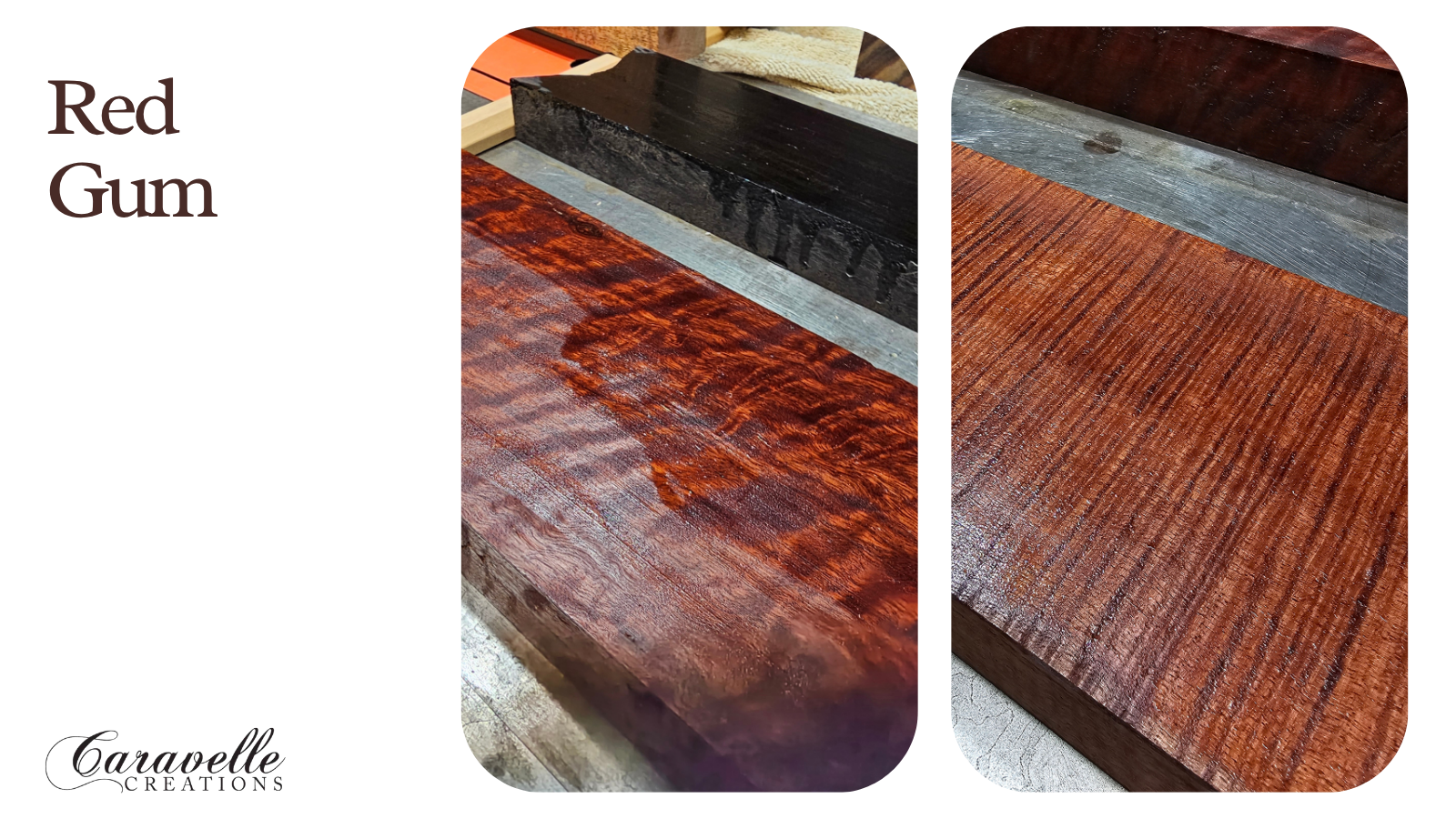
Red Gum is dense, hard, and strong. It has long been used for heavy-duty work, including construction, railway sleepers, furniture, and other applications where strength mattered. When a wood has that kind of background, it carries a different feeling into a decorative or functional object.
In a cane, that matters. A cane is held. It is carried. It is noticed up close. Red Gum gives the piece a sense of substance before anyone knows a thing about the species.
The Basics: Red Gum at a Glance
Scientific name:Eucalyptus camaldulensis
Common names: River Red Gum, Red River Gum, Murray River Gum
Native region: Australia
Typical habitat: Rivers, creeks, wetlands, inland waterways, and floodplains
Tree size: Often around 100 to 150 feet tall, with trunks around 3 to 5 feet in diameter
Average dried weight: About 54 pounds per cubic foot
Janka hardness: About 2,160 lbf
Color range: Deep red, reddish brown, orange-red, and darker brown tones
Grain: Often interlocked, sometimes wavy
Natural luster: Medium to high
Workability: Moderate
Caravelle use: Cane bodies, handles, accents, and collector pieces where weight, color, figure, and story all matter
What Red Gum Looks Like
Red Gum earns its name honestly.
The timber can show deep red, red-brown, orange-red, and darker brown tones. Some pieces are cleaner and more even. Others show rugged streaks, curl, fiddleback-like movement, or grain that seems to shift under finish.
A good piece of Red Gum does not need a lot of help.
The finish is there to bring the color forward, not to create the color from scratch. That is an important distinction. Some woods need stain to look dramatic. Red Gum already brought its own drama.
The best pieces have depth. Not just “red,” but layers of red, brown, amber, and shadow. When the grain has movement, the whole piece can start to feel almost dimensional.
That is why Red Gum works so well in a cane. It has enough visual weight to hold attention across a long, narrow form. It does not disappear.
Why It Works in Custom Cane Making
A cane has to do two things at once.
It has to be useful.
And it has to feel worth carrying.
Red Gum brings a lot to that conversation. It is dense, strong, and naturally substantial. That gives a cane a sense of confidence. Not delicate. Not flimsy. Not decorative in a way that forgets the object still has a job.
But density also needs to be handled carefully.
A heavy wood in the wrong proportions can make a cane feel clumsy. The point is not to make something that feels like a table leg with a handle. The point is balance. Shape, weight, handle, collar, tip, finish, and grain all have to work together.
That is where Red Gum gets interesting. It is strong enough to feel serious, but beautiful enough to justify slowing down and shaping it carefully.
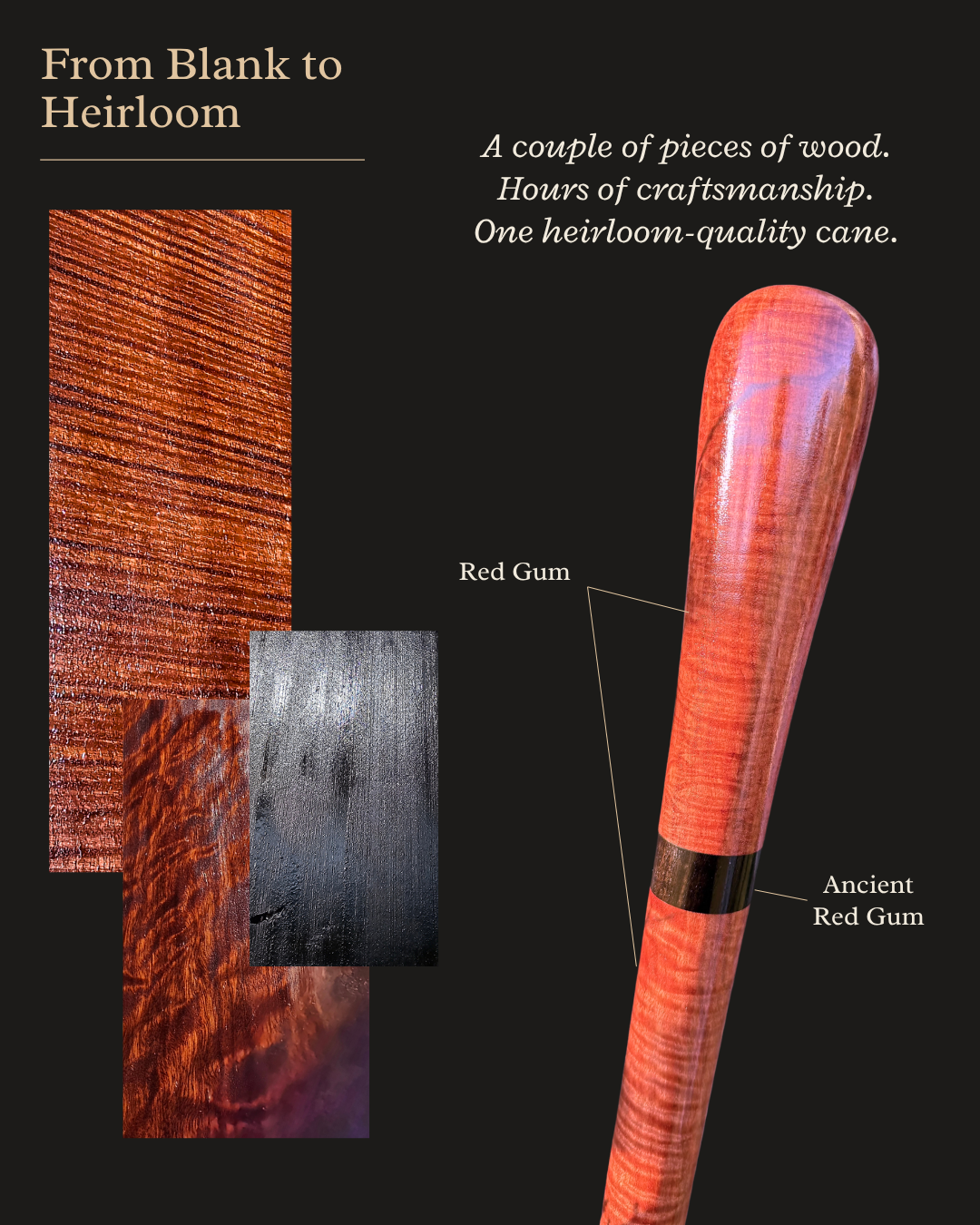
It also pairs well with other materials. Dark collars, metal dividers, resin, burl, maple, and other figured woods can all work with Red Gum because the color has enough authority to hold its own. Have you met “Simply Red?”
What Makes Ancient Red Gum Special?
Ancient Red Gum is the part of this story that stops people.
Regular Red Gum is already old in the way trees are old. Ancient Red Gum is old in a different way.
It usually refers to Red Gum that was buried underground, often in river systems or old channels, and preserved for thousands of years. Instead of simply rotting away, the wood was protected by the environment around it. Over time, minerals in the ground and water altered the wood.
The result can be dramatic.
Ancient Red Gum is often much darker than modern Red Gum. Some pieces are charcoal, black-brown, or nearly black. The darkness is not a surface stain. It can run deep into the wood because of the long mineral interaction that happened underground.
That is what makes it feel so different.
It is still wood, but it carries the look of something halfway between timber and stone. Dense. Dark. Heavy with time.
Some Ancient Red Gum has been radiocarbon dated at more than 5,000 years old, and other documented examples have been dated even older. That does not mean every piece sold as Ancient Red Gum is automatically the same age, so the honest answer is always this: the age depends on the specific source and whether it came with documentation.
But even without chasing the biggest number, the material itself is remarkable.
A piece of Ancient Red Gum has already had a long life before it ever reaches the bench.
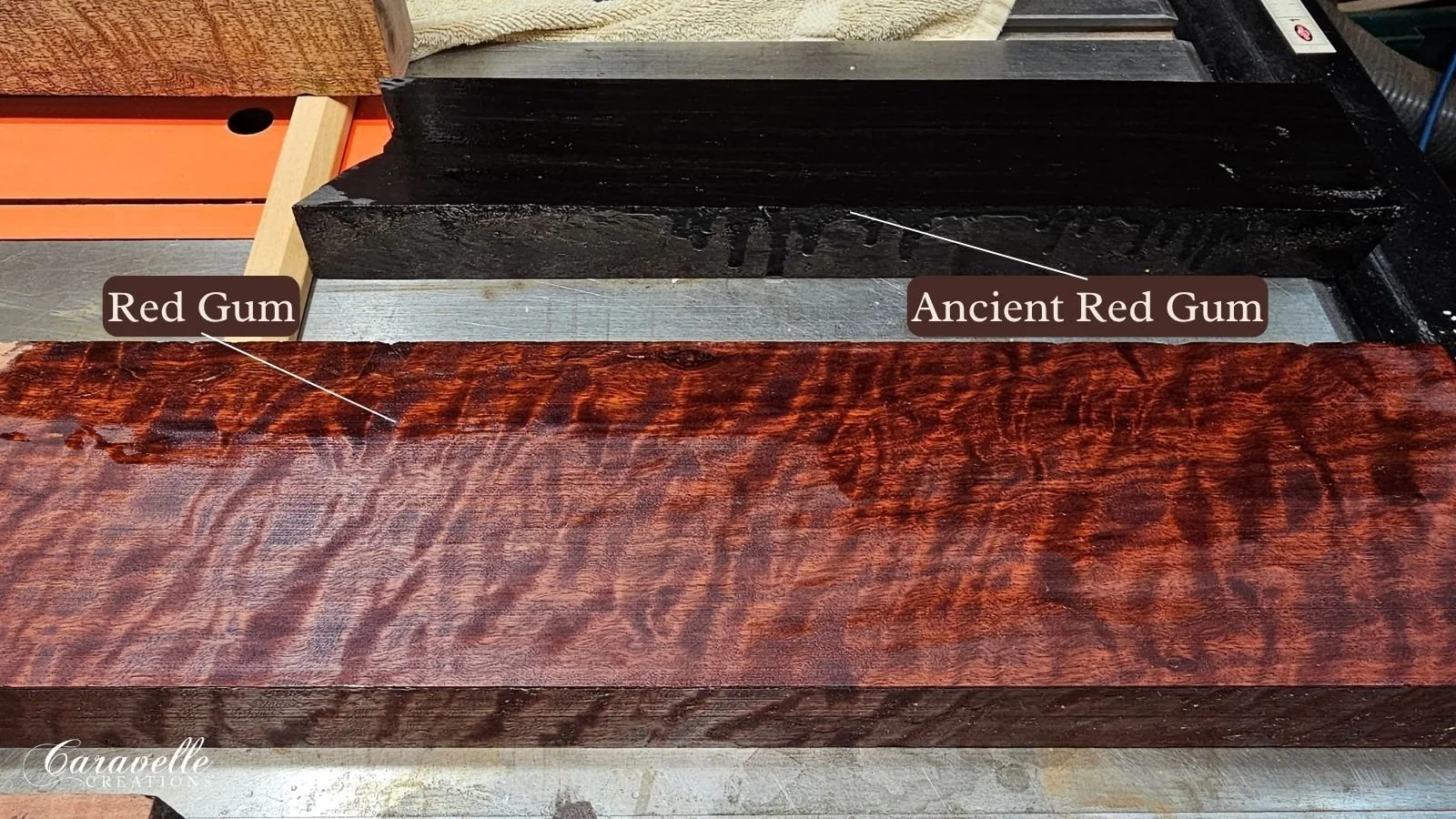
Red Gum vs. Ancient Red Gum
Regular Red Gum and Ancient Red Gum are connected, but they do not behave or look exactly the same.
Red Gum is known for deep red to reddish-brown color, strong grain, density, durability, and warmth. It can look bold and alive, especially when the grain has curl or figure.
Ancient Red Gum is usually darker, harder-feeling, and more severe in appearance. It can be black, charcoal, or dark brown because of the way it has been preserved and mineralized underground. It often feels less like “pretty hardwood” and more like a piece of deep time.
That contrast is what makes pairing them so good.
Red Gum brings fire.
Ancient Red Gum brings shadow.
Together, they can make a cane feel like it has both movement and gravity.
Why Collectors Notice It
Collectors tend to notice two things first: color and story.
Red Gum has both.
The color is strong enough to stand out without needing gimmicks. The grain can be rugged, wavy, or quietly complex. The density gives it a real physical presence. It feels like a material that was not chosen by accident.
Ancient Red Gum adds another layer. It is not just rare because it is hard to find. It is rare because it comes with history built into the material itself.
That matters in a handmade object.
A cane made with Ancient Red Gum is not just using “dark wood.” It is using wood that spent thousands of years underground before being recovered, cut, shaped, and given another life.
That is the kind of detail collectors remember.
Working With Red Gum
Red Gum is not the easiest wood on the bench, and that is part of why it has character.
It is dense. It can be hard. It can have interlocked grain, which means the fibers do not always run politely in one direction. That can make shaping and finishing more demanding.
Sharp tools matter. Patience matters. Grain direction matters.
The reward is a finish with depth and strength. When Red Gum is shaped well and polished properly, it can look rich without looking overly refined. It still keeps a little ruggedness, which I like.
Some woods look best when they are made perfect.
Red Gum looks best when it is respected.
There is a difference.
A Note on Sourcing
Red Gum has a long history of use in Australia, and Ancient Red Gum is often reclaimed or salvaged material. That makes sourcing part of the story.
With rare or unusual woods, the goal is not just to get an interesting piece. The goal is to use it well. Waste matters. Bad design matters. Poor execution matters.
A piece of Ancient Red Gum may have spent thousands of years waiting underground. That sounds dramatic, but it is also true enough to make you slow down before cutting into it.
Not every offcut needs to become a masterpiece, but special wood deserves thoughtful work.
What to Look For in a Red Gum Piece
If you are looking at a cane or custom object made with Red Gum, pay attention to:
Color depth: Good Red Gum should have warmth and richness, not a flat red-brown look.
Grain movement: Wavy or interlocked grain can create visual interest, especially under finish.
Weight and balance: Red Gum is dense, so the finished piece should feel substantial but not awkward.
Contrast: Red Gum pairs beautifully with darker accents, metal, resin, and Ancient Red Gum.
Finish quality: A good finish should bring out the natural depth of the wood without making it look plastic.
Material story: If a piece includes Ancient Red Gum, ask whether the source or age is documented.
Red Gum in One Sentence
Red Gum is a dense Australian hardwood known for its deep red color, strength, rugged grain, and serious presence.
Ancient Red Gum takes that further. It is not just wood with color. It is wood with time in it.
-
Red Gum wood usually refers to River Red Gum, Eucalyptus camaldulensis, a dense Australian hardwood known for its deep red to reddish-brown color, strength, durability, and natural grain movement.
-
It is commonly called River Red Gum because it grows along rivers, creeks, wetlands, and floodplains, and because its timber can show a deep red hue when cut, milled, or finished.
-
Yes. Red Gum is a hardwood. River Red Gum has a Janka hardness of about 2,160 lbf, making it considerably harder than many common domestic hardwoods.
-
Yes, Red Gum can be excellent for custom canes when the piece is selected and balanced properly. It offers strength, density, rich color, and visual presence, though its weight and grain need to be handled thoughtfully.
-
Red Gum can range from orange-red and deep red to reddish brown and darker brown tones. Figured pieces may show added movement, curl, or darker streaking.
-
Ancient Red Gum is typically reclaimed or preserved Red Gum that has spent thousands of years underground. Mineral interaction can darken the wood dramatically, sometimes making it nearly black and much harder-feeling than ordinary Red Gum.
-
Some documented Ancient Red Gum has been radiocarbon dated to more than 5,000 years old, with other examples dated even older. The exact age depends on the specific piece and whether it comes with documentation.
-
Ancient Red Gum darkens because of long-term preservation underground and interaction with minerals, water, iron, silica, and tannins. The process can darken the wood through the center, not just on the surface.
-
It is often described as being in a stage before fossilization or as semi-fossilized, depending on the source. It is still wood, but it may be heavily mineralized, darkened, and much harder than modern Red Gum.
-
Red Gum is collectible because of its strong color, density, durability, natural grain movement, and connection to the Australian landscape. Ancient Red Gum adds rarity and history, which makes it especially appealing in small handmade pieces.