
Anatomy of a Cane: Every Part, Handle Style and Shaft Style
A cane looks simple until you start making them. Then you find out that every part has a name, a job, and a few dozen ways to get it wrong.
This guide walks through a cane from top to bottom: what each part is called, what it does, and the classic styles you'll run into for handles and shafts. The examples come from canes made here at Caravelle Creations, so you can see what each term looks like on a real, handmade piece.
What are the parts of a cane?
A walking cane has four main parts: the handle at the top, the collar where the handle meets the shaft, the shaft (the long body of the cane), and the tip at the bottom. Some of our canes add a fifth: a protective section of contrasting wood at the base that we call a boot.
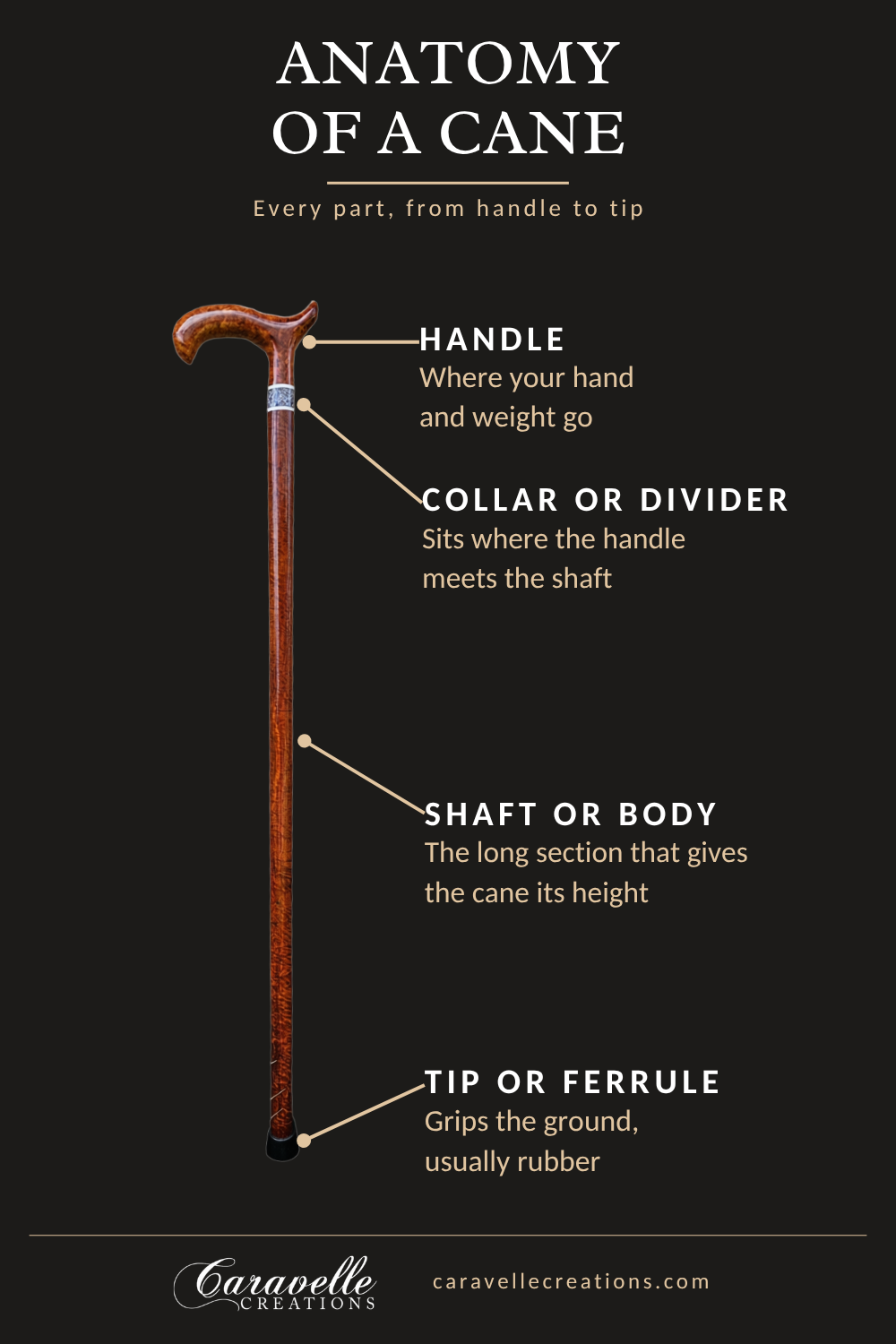
Each part has its own job. The handle carries your hand and your weight, the collar joins and protects the connection, the shaft gives the cane its height and strength, and the tip keeps it from slipping and wearing down.
The handle
The handle is the part of the cane you hold. It's where you put your weight, so its shape decides how the cane feels in your hand, how well it supports you, and whether it can hang on a table edge or your arm when you're not using it.
On a hooked handle like a crook, the parts of the curve have their own names. The horn is the short end of the hook, and the mouth is the open space between the horn and the shaft. On a flat-topped handle like a derby, the palm rest is the part your palm sits on.
The handle is also where a maker usually shows off. Because it's the first thing anyone sees, it's often carved from the most striking wood in the cane, like the pink ivory handles in my Unicorn Collection (dropping soon) or the amboyna burl handles in the Narra Collection.
The collar
The collar is the band where the handle meets the shaft. It can be structural, reinforcing the joint, or purely decorative, hiding the seam between two pieces of wood. On many handmade canes it does both.
Collars are a chance to add contrast. A few examples from my bench: Unicorn Collection No 3 has a sterling silver collar between a pink ivory handle and a Gabon ebony shaft. Unicorn No 4 uses ebony bordered with brass. The Narra Collection No. 1 has silver leaf suspended in deep purple resin, bordered with aluminum. In my shop, "collar" and "divider" mean the same thing, and I use both.
The shaft (body)
The shaft is the long part of the cane between the collar and the tip. It gives the cane its height and carries your weight to the ground, so it has to be strong without being too heavy. I call it the body as often as the shaft. The two words mean the same thing.
Shafts can be made from almost anything: wood, aluminum, carbon fiber, even horn or bone on antique canes. On a handmade wooden cane, the shaft is where you see the most wood at once, so its grain and color set the tone for the whole piece.
The boot
At Caravelle, a boot is our name for a section of contrasting wood at the bottom of the shaft. It protects the end of the cane from scuffs and moisture, and visually it grounds the cane, the way a dark baseboard finishes a wall. Unicorn Collection No 2, for example, is nearly all pink ivory with an ebony boot.
The tip and ferrule
The tip is the end of the cane that touches the ground. On most modern canes, including every cane I make, it's a replaceable rubber tip, which grips the floor and absorbs some of the shock with each step.
You'll also hear the word ferrule. Traditionally, a ferrule is a metal cap or sleeve on the bottom of the shaft that protects the wood from wear and splitting. Today, people often use "ferrule" and "tip" to mean the same thing. Whatever you call it, check it regularly. A worn rubber tip loses its grip and can let a cane slip.
What are the different cane handle styles?
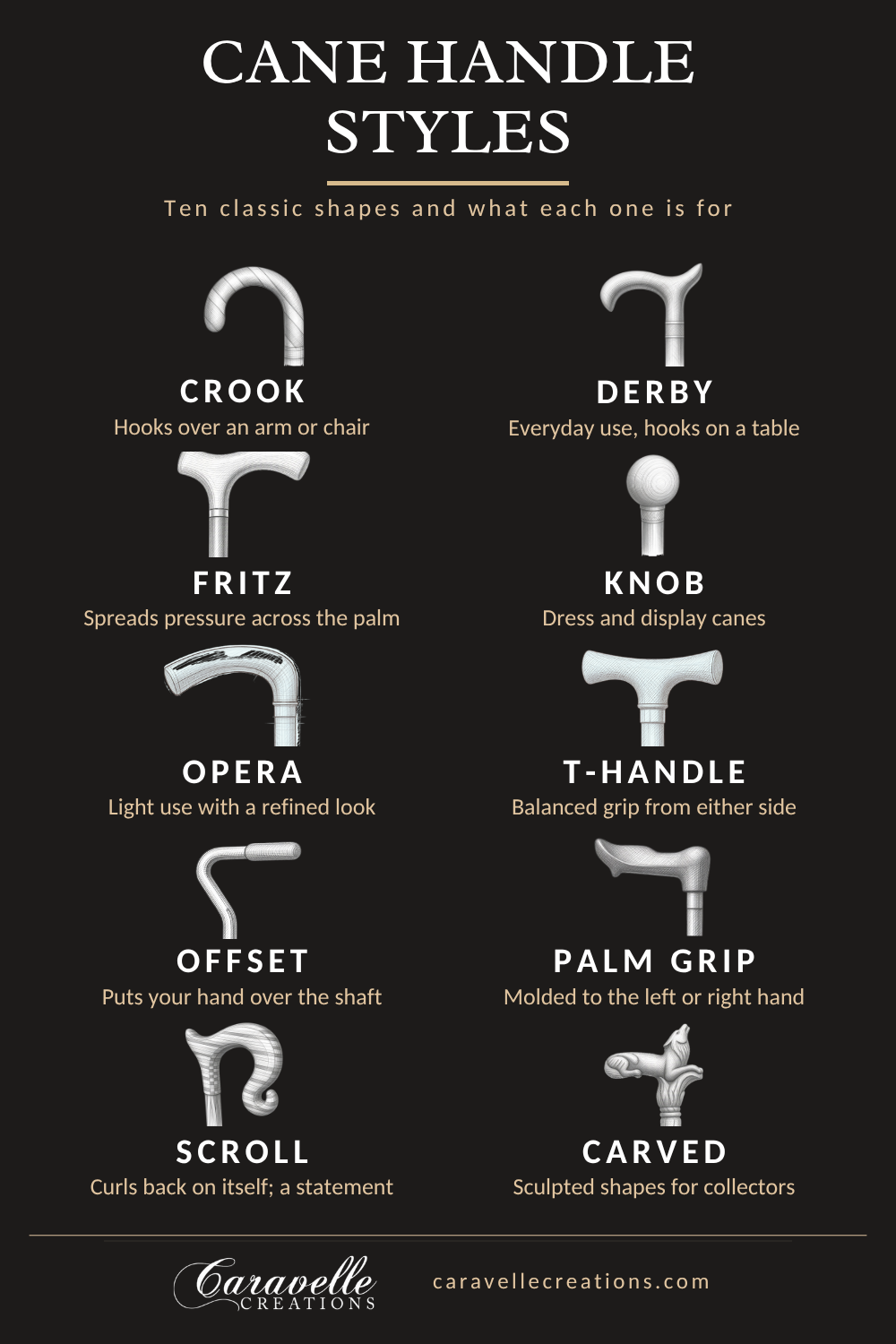
There are about ten classic cane handle styles, and each one balances comfort, support and looks differently. The most common are the crook, derby, fritz and knob, with specialty shapes like offset and palm grip handles designed for more support.
| Handle style | Shape | Best for |
|---|---|---|
| Crook (tourist) | Upside-down J hook | Hanging on an arm or chair; classic look |
| Derby | Flat top with a hook curling back | Everyday use; weight over the shaft |
| Fritz | Broad and flat, ends curve down | Hand pain or arthritis; spreading pressure |
| Knob | Rounded ball on top | Dress and display canes; light use |
| Opera | Short, slim and horizontal | Light, occasional use; a refined look |
| T-handle | Straight crossbar | A balanced grip from either side |
| Offset | Shaft bends under the grip | Maximum support |
| Palm grip | Molded to the left or right hand | Spreading pressure across the palm |
| Scroll | Curls back on itself | Statement and collector canes |
| Carved | Animal heads and sculpted shapes | Collectors; canes as art |
Crook (tourist) handle. The classic upside-down J. It hooks over your arm or a chair back, which makes it handy, but your weight sits slightly in front of the shaft rather than directly over it.
Derby handle. A flatter top with a hook that curls back toward the shaft. It puts your weight more directly over the cane and still hooks onto a table edge. It's one of the most popular handle styles.
Fritz handle. A broad, flat handle that spreads pressure across the whole palm, with ends that curve gently down. It's often recommended for people with arthritis or hand pain.
Knob handle. A rounded top that sits in the cup of your palm, also called a ball or pommel handle. It's a classic on dress canes and display canes, though it offers less grip for heavy support.
Opera handle. A short, slim, horizontal handle with a refined look. It works best for lighter, occasional use.
T-handle. A straight crossbar on top of the shaft. It's simple and balanced, and easy to grip from either side.
Offset handle. Common on medical canes, the shaft bends just below the handle so your hand sits directly over the cane's center line. It offers the most support of the traditional shapes.
Palm grip (ergonomic) handle. Molded to the shape of a left or right hand, so the pressure spreads across the palm. You choose it by hand and size.
Scroll handle. A handle that curls back on itself at one end, like the scroll of a violin. Unicorn Collection No 3 has one carved from pink ivory.
Carved and figural handles. Animal heads, faces and other sculpted shapes. They're less about ergonomics and more about art, which is why collectors love them.
What are the different shaft styles?
Cane shafts come in several basic forms: straight, tapered, spiral, laminated, segmented and natural. The style changes how the cane looks, how much it weighs and how it feels in motion.
Straight. One even thickness from top to bottom. It's clean and classic, and it shows off a single piece of beautiful wood.
Tapered. Thicker near the handle and slimmer toward the tip, which saves weight without giving up strength where it counts. The Tung Vu cane tapers from just over 1 1/8 inches at the handle to just under 1 inch at the bottom.
Spiral or twist. Carved so the shaft twists along its length. Unicorn Collection No 4 has a spiral-carved jatoba shaft.
Laminated or striped. Several woods glued together, so stripes of color run down the shaft. Narra Collection No. 2 and No. 3 combine narra, yellowheart and ebony in stripes that spiral down the cane.
Segmented. Sections of different woods stacked end to end, often divided by thin accent bands.
Natural. A branch or root shaped by the tree itself, with the bark or knots sometimes left on. It's common on rustic walking sticks.
Fluted or faceted. Grooves cut along the length, or flat sides (an octagonal shaft has eight), for grip and visual detail.
What's the difference between a cane, a walking stick and a hiking staff?
A walking cane has a handle shaped to carry your weight and is sized to your wrist, so it supports you with every step. A walking stick is usually a straighter, simpler stick used for balance on uneven ground. A hiking staff is taller still, held higher, and used mainly on trails. In everyday speech, people often use "cane" and "walking stick" interchangeably.
What are the main types of canes?
Most canes fall into a handful of types, depending on whether they're built mainly for support, style or a special purpose.
Everyday walking canes. A single shaft with a supportive handle, used for balance and to take pressure off a leg or joint.
Dress and fashion canes. Canes chosen as much for style as support. For centuries they were a mark of status, with handles in silver, ivory or carved wood.
Collector and art canes. Handmade, one-of-a-kind canes valued for their materials and craftsmanship, often from exotic woods.
Adjustable and folding canes. Usually aluminum, with a push-button height adjustment or sections that fold for travel.
Quad canes. A cane with a four-footed base that stands on its own and offers extra stability.
Seat canes. Canes that unfold into a small seat.
System or gadget canes. A 19th-century favorite: canes that hid something inside, like a flask, a telescope or opera glasses.
How do you choose the right cane?
Start with the handle, because that's where your hand and weight go. Choose a fritz, offset or palm grip handle if you need firm support or have hand pain, and a derby or crook if you want a classic look with a handy hook. Then choose the shaft for weight and style, and finally get the height right.
Height matters more than most people think. A cane that's too tall or too short changes your posture with every step. Our guide on how to size a cane properly walks through measuring from the floor to your wrist crease. Every Caravelle cane can be cut to your height.
If the woods themselves are what draw you in, the Deep in the Woods series covers the species behind each cane, and our guide to woodworking terms explains words like figure, burl and chatoyance.
Cane anatomy FAQ
Frequently Asked Questions About Cane Parts
-
The handle, also called the grip. On hooked handles, the curved end is the horn, and the space inside the curve is the mouth.
-
The tip. A rubber tip grips the floor and can be replaced when it wears down. A metal cap or sleeve at the bottom is called a ferrule.
-
Handles that spread pressure across the palm, like the fritz, offset and palm grip (ergonomic) styles, are usually the most comfortable for arthritis or hand pain.
-
On a handmade cane, yes. The maker chooses the pairing, and the collar joins them. Mass-produced canes usually come with the handle and shaft already set.