
Australian Buloke: The Wood That Fights Back
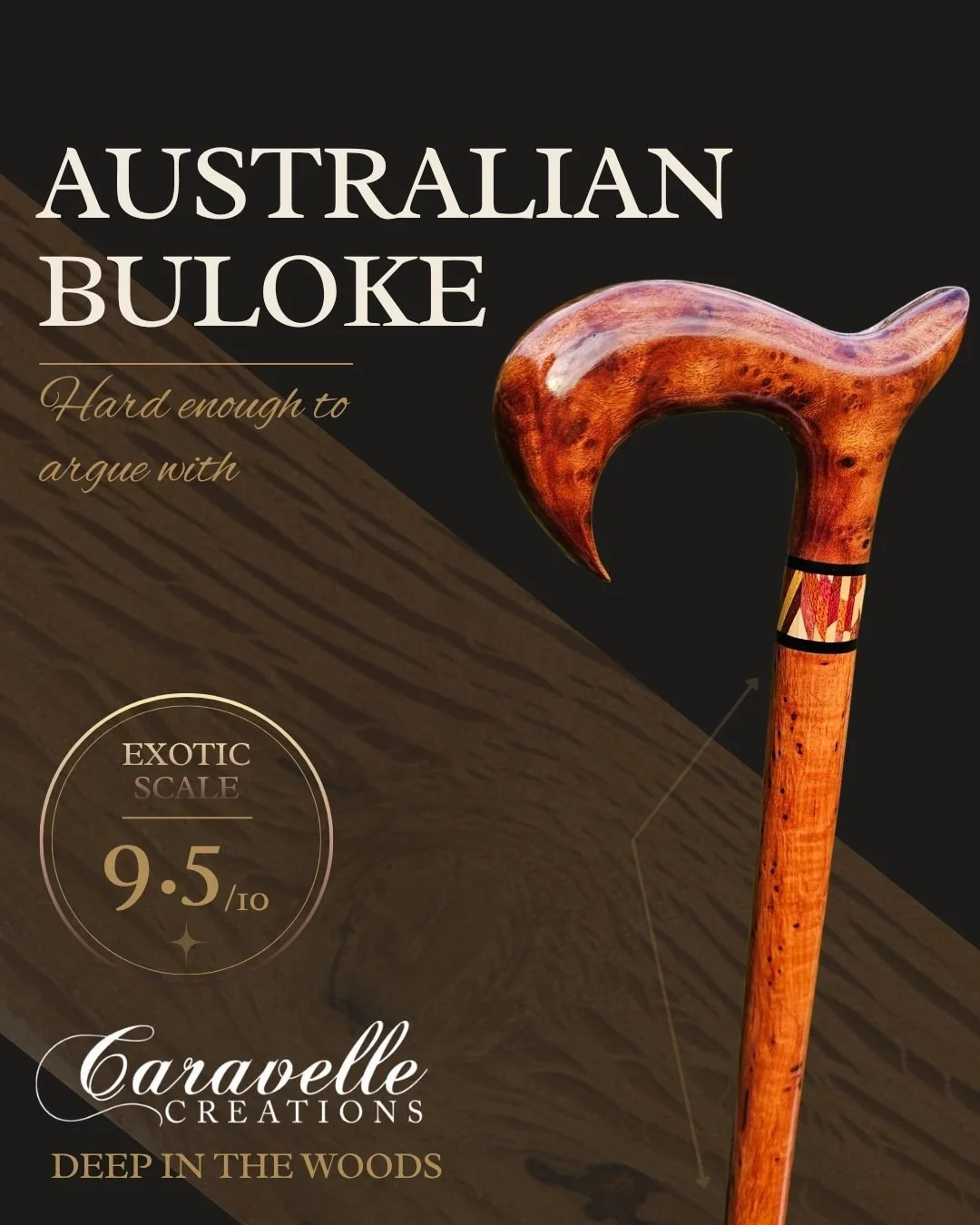
Every woodworker has a short list of woods they talk about with a mix of respect and dread. Australian buloke sits near the top of that list. It's famous for its hardness, it's hard to find outside Australia, and it has a quiet, lace-like figure that most people never get to see in person.
What is Australian buloke?
Australian buloke is the timber of Allocasuarina luehmannii, a tree native to inland eastern Australia. It's one of the densest and hardest woods on the Janka hardness scale, which is why woodworkers know it by reputation even if they've never held a piece.
The tree is also called bull oak, and the Wiradjuri people of New South Wales call it Ngany. Despite the "oak" in its name, it isn't an oak at all. It belongs to the she-oak family (Casuarinaceae).
Quick facts:
Australian buloke - Common names: Australian buloke, buloke, bull oak
Scientific name: Allocasuarina luehmannii (formerly Casuarina luehmannii)
Native range: Inland eastern Australia, from Queensland through New South Wales to north-western Victoria and South Australia
Janka hardness: 3,760 to 5,060 lbf, depending on the source
Average dried weight: about 70 lbs/ft³ (1,085 kg/m³)
Color and grain: Reddish-brown heartwood with pale yellowish-brown sapwood; straight to slightly interlocked grain; fine, even texture
Typical uses: Knife handles, turned objects, fine furniture, flooring
Is buloke really the hardest wood in the world?
Buloke is often called the hardest wood in the world, but the answer depends on which test you trust. Many older references list it at about 5,060 lbf on the Janka scale, which would put it at the top of the chart. The Wood Database's current listing uses a single test result of 3,760 lbf, which ranks it around 21st worldwide.
Either way, it belongs in the same conversation as the hardest woods anyone can buy. The Janka test measures the force needed to press a small steel ball halfway into the wood, so a high number means a surface that shrugs off dents. Here's how buloke compares with other woods we've covered and two familiar hardwoods:
| Wood | Scientific name | Janka hardness |
|---|---|---|
| Australian buloke | Allocasuarina luehmannii | 3,760 to 5,060 lbf |
| Gabon ebony | Diospyros crassiflora | about 3,080 lbf |
| River red gum | Eucalyptus camaldulensis | about 2,160 lbf |
| Hard maple | Acer saccharum | about 1,450 lbf |
| Narra | Pterocarpus indicus | about 1,260 lbf |
| Red oak | Quercus rubra | about 1,220 lbf |
Even at the lower figure, buloke is about three times harder than red oak.
In Jim's words: "It's the hardest wood I've ever worked with!"
What does Australian buloke look like?
Buloke heartwood is a warm reddish brown with a fine, even texture and a good natural luster. Its most distinctive feature is its rays, the thin bands of cells that run outward from the center of the tree. In buloke they're unusually large, so a quartersawn board shows a lace-like pattern of flecks across the surface.
Some boards also show birdseye figure: small, round "eyes" scattered through the grain that catch the light as you turn the piece. A birdseye board gives you buloke's toughness with a lot more to look at. If you're new to terms like rays and figure, our guide to woodworking terms covers the basics.
Why is buloke so hard to work?
Buloke's density makes it hard on tools and slow at the bench. The Wood Database notes it can be difficult to work because of its hardness, and that tearout can happen when planing, especially across the large rays on quartersawn surfaces.
That lines up with Jim's own shop ratings for the piece in the carousel above. On his Caravelle Craftsman's Ratings, he gave buloke 5 out of 5 for grain beauty, 2 out of 5 for chatoyance, 1 out of 5 for ease of working, and the maximum score for bench time. Those are his judgments from the bench, not a lab test, but they tell you what the number on the Janka chart feels like in practice.
Where does buloke grow?
Buloke grows in scattered woodland across inland eastern Australia, from Queensland south through New South Wales and the Australian Capital Territory to north-western Victoria and nearby South Australia. It rarely grows near the coast. The trees usually reach about 30 to 50 feet tall with trunks 1 to 2 feet across.
Those woodlands matter well beyond woodworking. The Buloke Woodlands of the Riverina and Murray-Darling Depression bioregions are listed by the Australian Government as a threatened ecological community, and the endangered south-eastern red-tailed black cockatoo depends on buloke seeds as one of its main foods. Buloke timber is seldom sold outside Australia, and the pieces that reach woodworkers usually come as small blanks at high prices.
Is Australian buloke good for a walking stick?
Australian buloke makes an extremely tough walking stick. Its hardness resists dents and wear, and its density gives a cane a solid, planted feel. The trade-off is weight: at about 70 pounds per cubic foot, buloke is heavier than most cane woods, so it can make sense to pair it with a lighter or more decorative handle.
That's how Jim approached The Bad Boy, a cane with an Australian birdseye buloke body under an Indonesian bayur burl handle. The buloke carries the load, and the burl brings the figure up top. Like every Caravelle cane, a buloke cane can be cut to length, and our guide on how to size a cane walks through getting the height right.
Buloke FAQ
-
They're relatives. Buloke belongs to the she-oak family, Casuarinaceae, along with the trees commonly sold as she-oak or sheoak. Each is its own species with its own wood.
-
Yes. Dry buloke has a specific gravity of about 1.09, which is denser than water, so a dry piece sinks.
-
"Buloke" and "bull oak" are both common names for Allocasuarina luehmannii. Whatever the name suggests, the tree isn't a true oak. Oaks belong to a different family entirely.
-
The long green strands that look like pine needles are actually branchlets. Buloke's real leaves are tiny scales arranged in rings around each branchlet.
A last word from the shop
Some woods are chosen for their color, and some for how easy they are to shape. Buloke earns its place by refusing to give an inch. It takes more time, more sharpening and more patience than almost anything else on the bench, and the finished piece carries that toughness with it.